
Myth: An Offshore Licence Makes It Legal for Me
PlayDash operates through Overtensis Limitada under Anjouan licence ALSI-202410062-FI2. Current licence-monitoring data lists that licence as active and connects PlayDash domains including playdash.io, playdash.net and playdash66.com with the operator.
That establishes the regulatory framework used by the operator. It does not create a universal permission for anyone in any country to gamble online.
The Limits of an Offshore Gambling Licence
An offshore gaming licence regulates an operator under the rules of the issuing jurisdiction. It is not a Malaysian gambling licence and does not replace legislation in the player’s own location.
The distinction is easier to see in practical terms:
| What the Anjouan licence can establish | What it does not establish |
| Which operator holds the gaming licence | That gambling is legal in every player’s country |
| Which domains are linked to the licence | That every country must accept PlayDash |
| Regulatory conditions applying to the operator | That local authorities cannot restrict access |
| A framework for operator compliance | A personal legal exemption for the player |
Malaysia is a good example of why these layers matter. The Malaysian Communications and Multimedia Commission has documented blocking of gambling-related sites under Malaysian law and continues to describe gambling sites among content that may be restricted through local network controls.
For a Malaysian reader, the offshore licence and Malaysian legal environment therefore need to be considered separately.
Myth: If the Site Opens, I Am Allowed to Play
Technical access only shows that a browser can reach a domain. It says nothing by itself about account eligibility.
PlayDash also chooses where to establish dedicated market portals. Its current official portal identifies separate PlayDash operations for Malaysia, Singapore and Thailand, with country-specific domains and landing pages.
The Served Markets Versus Restricted Territories
The clearest current public evidence points to these Asian markets as actively targeted by PlayDash:
- Malaysia — dedicated MY portals and Malaysian-facing access;
- Singapore — dedicated SG portals;
- Thailand — dedicated TH portals.
Those markets should not be confused with a global promise of availability.
| Market status | Current public evidence |
| Malaysia | Dedicated PlayDash MY portals |
| Singapore | Dedicated PlayDash SG portals |
| Thailand | Dedicated PlayDash TH portals |
| United Kingdom | Excluded under the Anjouan licensing framework |
| United States | Excluded under the Anjouan licensing framework |
| Other locations | Depends on operator eligibility rules and local law |
Anjouan’s licence-validation framework expressly excludes territories including the United Kingdom and United States, among other prohibited jurisdictions.
The practical lesson is not to build a country list from whether a URL loads. Market support, licence exclusions and local rules are separate checks.
Myth: Being on the KYC List Means You Can Play
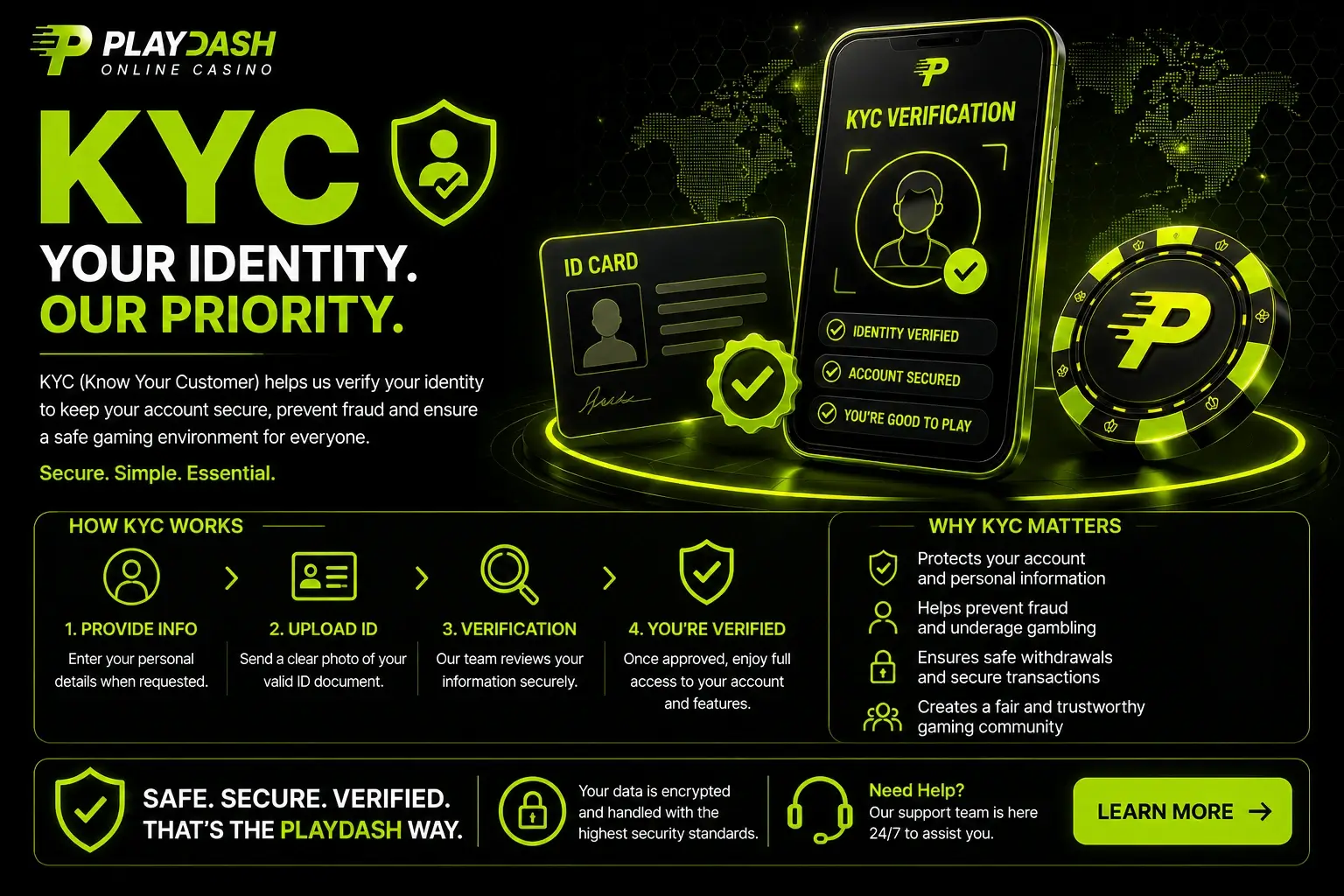
KYC and AML systems serve a different purpose from geo availability.
PlayDash-facing privacy material shows that the operator can collect identity data, residential address, payment information, transaction history, IP address and verification documents as part of KYC, anti-money-laundering and fraud controls.
A country appearing in a verification process therefore does not automatically mean PlayDash actively accepts players from that jurisdiction.
Why an AML List Stretches Wider Than the Market List
AML screening has to identify risk, verify identity and understand where money and account activity originate. That can require a wider set of country references than the operator’s actual commercial footprint.
The two systems answer different questions:
- market availability asks where PlayDash intends to provide its service;
- KYC asks whether the account holder is who they claim to be;
- AML controls assess financial and fraud-related risks;
- geo controls consider where the user appears to be connecting from;
- local law determines what rules apply in the user’s jurisdiction.
A country appearing in an identity-document list or risk database should therefore never be treated as proof that registration from that country is authorised.
Myth: A VPN Turns a Blocked Country Into an Open One
A VPN can change how an internet connection is routed, but it cannot change nationality, residence, account eligibility or local gambling law.
There is an important PlayDash-specific nuance here. The PlayDash Community itself has recommended Cloudflare WARP to improve connection stability or reach the service when an ISP interferes with access. In other words, current public material does not support the blanket claim that merely switching on a VPN is automatically a PlayDash terms violation.
What matters much more is whether VPN use is combined with false account information or an attempt to disguise an ineligible location.
The Account and Payout Risk of Faking a Location
PlayDash-related terms prohibit false identity information and allow verification documents to be requested. Failure to complete verification can lead to account suspension, while prohibited conduct can result in closure or withheld balances.
Problems can therefore arise when a user’s digital location and verified details tell different stories.
Typical risk points include:
- registering with a false country or residential address;
- submitting identity documents that do not support account details;
- using a payment method that conflicts with the verified identity;
- attempting to bypass a territory restriction rather than simply improving connectivity;
- reaching withdrawal review with information that cannot be verified consistently.
This distinction matters. A privacy or connectivity tool is not the same thing as falsifying residence. A VPN may make a page technically reachable, but it cannot turn an excluded jurisdiction into an authorised one.
What Actually Decides Your Access
There is no single PlayDash country test. Availability is the result of several layers working together.
| Factor | What it decides |
| Anjouan licence | The operator’s offshore regulatory framework |
| PlayDash market policy | Which countries receive dedicated service and account access |
| Local law | Whether gambling activity is permitted or restricted where the player is located |
| KYC and AML | Whether identity, residence and financial information can be verified |
| Payment infrastructure | Whether supported deposits and withdrawals are available for that market |
| Network access | Whether the domain can technically be reached |
For Malaysian readers, PlayDash clearly maintains Malaysia-specific portals and presents the country as one of its principal markets. That commercial targeting still does not override Malaysian law or remove the need for successful verification.
Before treating PlayDash as available from any location, separate these questions:
- Is the country actually served by PlayDash?
- Is it excluded by the operator’s licensing framework?
- What does local law say about online gambling?
- Can the account holder verify their genuine residence and identity?
- Are appropriate payment channels supported?
- Is the website opening normally, or is technical access masking a broader eligibility issue?
A working link is only one part of that picture. The more reliable test combines the operator’s market policy, licensing limits, local rules and the information that must ultimately survive KYC.
That is particularly important when travelling or moving between countries. Technical access can change immediately, while account eligibility, residence and regulatory restrictions do not change simply because the IP address does.