
| Zone | What it usually looks like | Sensible response |
| Green | Budget and time limits remain intact | Keep the boundaries in place |
| Amber | Spending, time or emotions begin to shift | Reduce access and reassess habits |
| Red | Control is repeatedly lost | Use stronger limits, a break or self-exclusion |
Green: Play That Still Looks Healthy
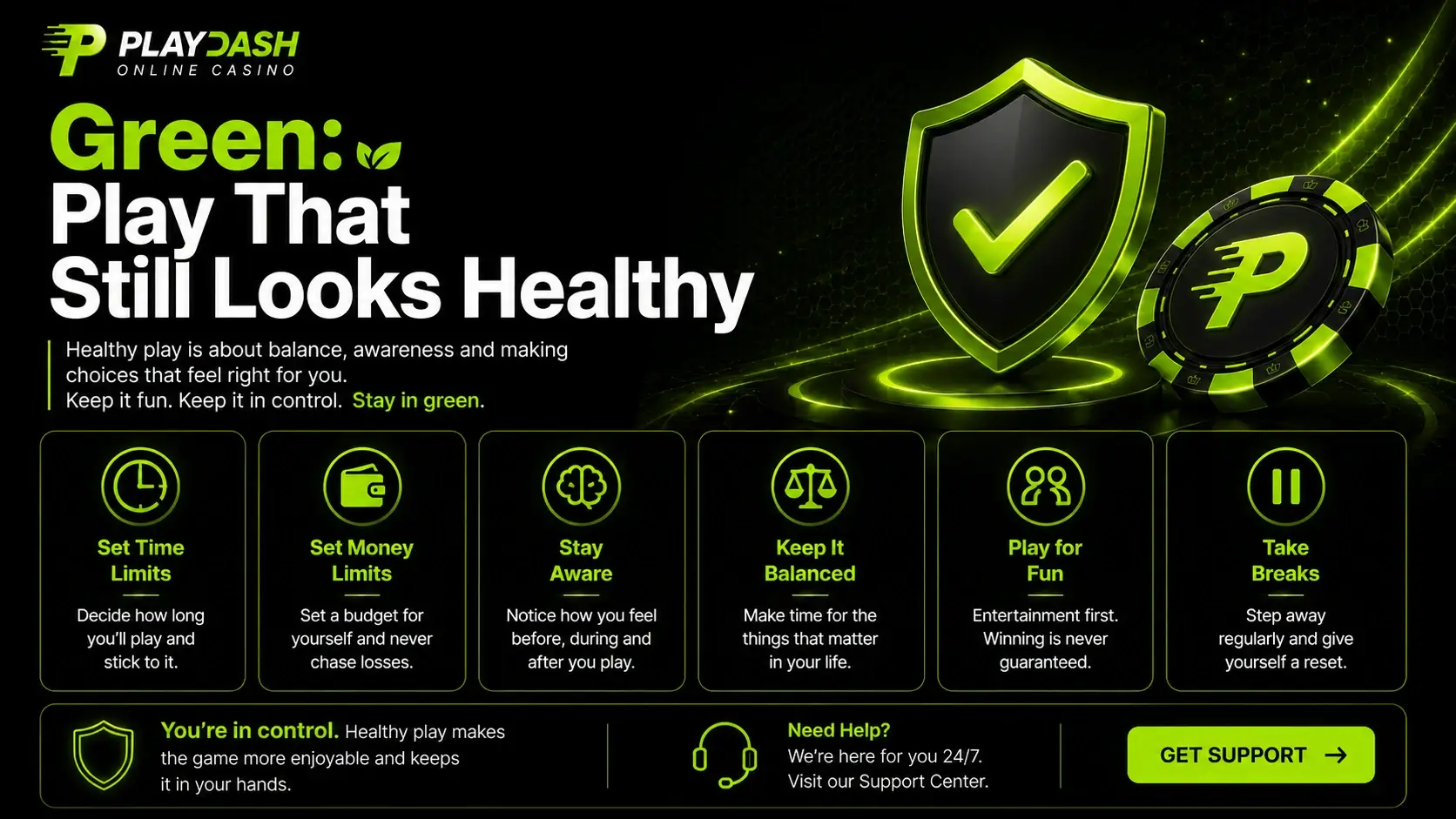
Controlled gambling has boundaries before the first bet or spin. The amount available for entertainment is separate from money needed for rent, food, bills, savings, debt repayments or other commitments. Time is also planned rather than left open-ended.
A loss can still be disappointing, but it does not create a need to win the money back immediately. Stopping at the planned point remains possible even when a session has gone badly.
The strongest time to set these rules is before gambling starts, when decisions are less affected by excitement or frustration.
Set Money and Time Limits Before You Sit Down
A basic budget does not need complicated calculations. It needs a clear maximum that still feels acceptable if the entire amount is lost.
Useful rules include:
- choose a fixed entertainment budget before opening PlayDash;
- use only disposable money, never rent, bill or borrowed funds;
- decide how long the session will last in advance;
- do not add another deposit because the first budget has gone;
- stop when either the money limit or time limit is reached;
- never increase the next stake simply to recover an earlier loss.
PlayDash-facing Malaysia material describes responsible-gaming controls including deposit limits, session limits and self-exclusion. These tools work best when they support limits already chosen while thinking clearly, rather than being activated only after control has slipped.
Amber: The Early Warning Signs
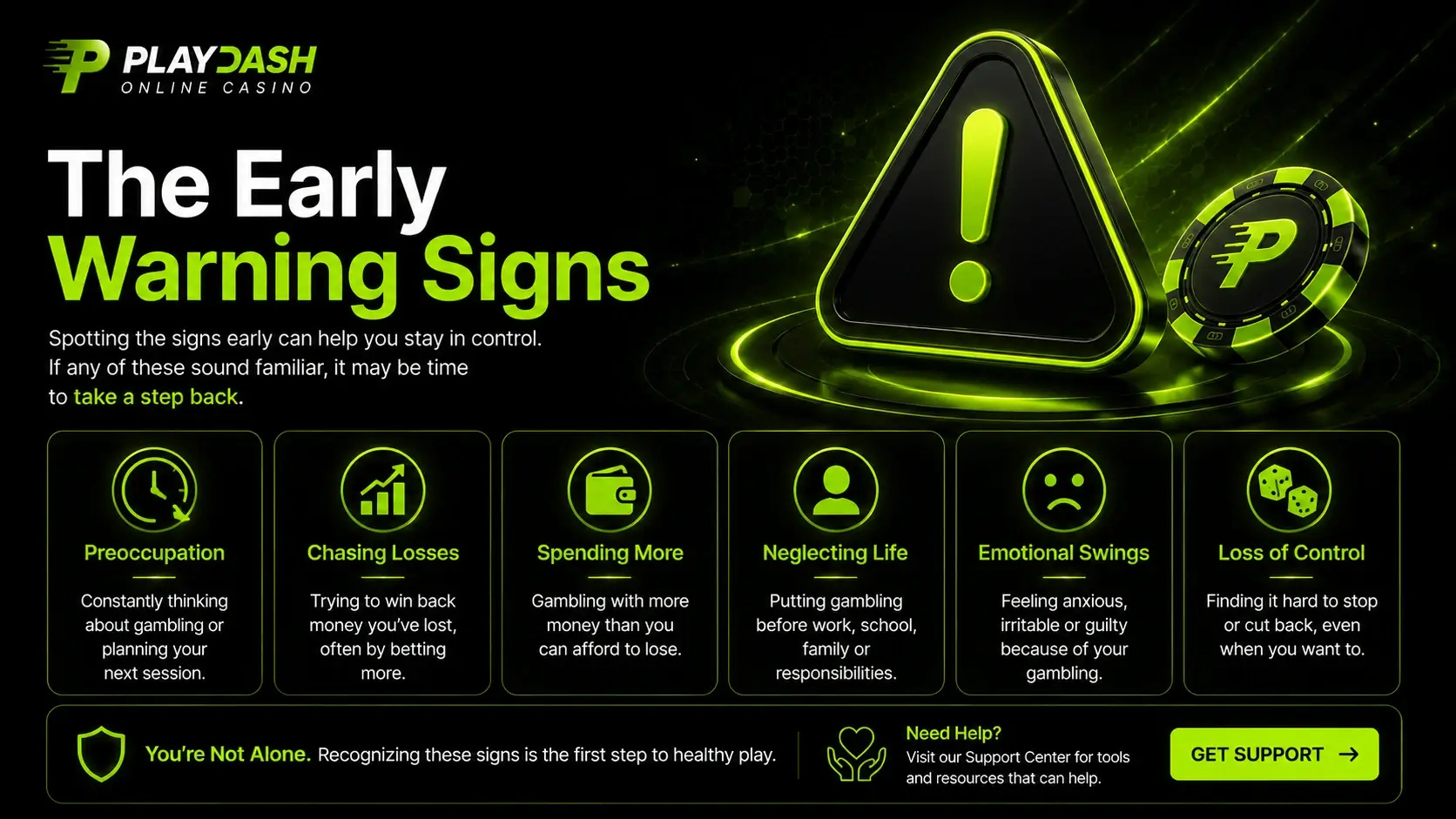
Amber does not necessarily mean that gambling has already become severe. It means the pattern deserves attention.
Changes often appear first in spending, time or emotional reactions. One unusual session is less informative than a pattern that keeps repeating. If several warning signs start appearing together, reducing gambling early is usually easier than waiting for them to become more disruptive.
What the Money and the Clock Start Showing
Financial and time-related changes are among the clearest signals because they can be compared with earlier behaviour.
Amber signs can include:
- deposits becoming larger or more frequent;
- stakes gradually increasing without a planned reason;
- returning quickly after a loss to try to recover it;
- extending a session beyond the original stopping time;
- gambling more often than intended;
- postponing work, sleep, plans or routine responsibilities;
- thinking about the next deposit while still playing.
Chasing losses deserves particular attention. Malaysia’s Ministry of Health includes returning to gamble in order to “get even” among the recognised indicators associated with gambling disorder, alongside increasing amounts and repeated difficulty cutting back.
What Mood and Secrecy Start Showing
Money is not the only signal. Gambling can also start changing how a person feels before, during and after a session.
Persistent irritation when unable to play, anxiety about losses, guilt after gambling or using casino sessions mainly to escape stress can all belong in the amber zone. Hiding deposits, session length or losses from a partner, friend or family member is another important change.
The combination matters more than one isolated bad mood. If gambling increasingly brings secrecy, stress and repeated attempts to recover money, the pattern is no longer just about entertainment. Malaysian clinical guidance identifies gambling when distressed and lying to conceal the extent of gambling among recognised problem indicators.
Red: When It Is Time to Step In
The red zone begins when ordinary intentions repeatedly stop working. Promising to spend less is not enough if the next session regularly breaks the same promise.
At that point, practical barriers are more useful than relying only on willpower. Responsible-gambling tools can restrict money or access, while a full break creates distance from the cycle altogether.
Deposit Caps, Cooling-Off, and a Full Break
PlayDash’s public Malaysia-facing material lists responsible-gaming sections and self-exclusion, while current PlayDash-focused sources describe deposit limits and temporary cooling-off options as account controls.
| Tool | When it can make sense | What it changes |
| Deposit limit | Spending is beginning to rise | Caps how much can be added |
| Cooling-off | A temporary interruption is needed | Stops access for a defined break |
| Self-exclusion | Returning repeatedly is causing harm | Creates a stronger barrier to gambling |
A deposit cap may be enough when the main problem is overspending but other boundaries still hold. Cooling-off is stronger because it removes the immediate opportunity to continue. Self-exclusion is intended for situations where a short break or spending limit is no longer sufficient.
Once an exclusion period has been activated, it should be treated as a firm commitment rather than something to shorten when the urge to return appears. Exact durations and reactivation rules should be taken from the current PlayDash self-exclusion terms because public PlayDash-facing sources do not describe them consistently.
When the Platform Raises the Flag First
PlayDash-related privacy material states that engagement patterns may be monitored for responsible-gaming purposes and that activated limits and self-exclusion can be enforced by the platform. Other PlayDash material also refers to detecting problem-gambling patterns as part of responsible-gambling processing.
That means responsible gambling is not limited to a button a player presses after recognising a problem. Account activity and behavioural signals can also form part of the operator’s risk controls.
However, public PlayDash material does not clearly establish a specific automatic rule such as “a certain number of losses triggers self-exclusion.” Any restriction imposed by the operator should therefore be understood as an account-protection measure rather than assumed to follow a fixed loss threshold.
Help That Waits Outside the Casino
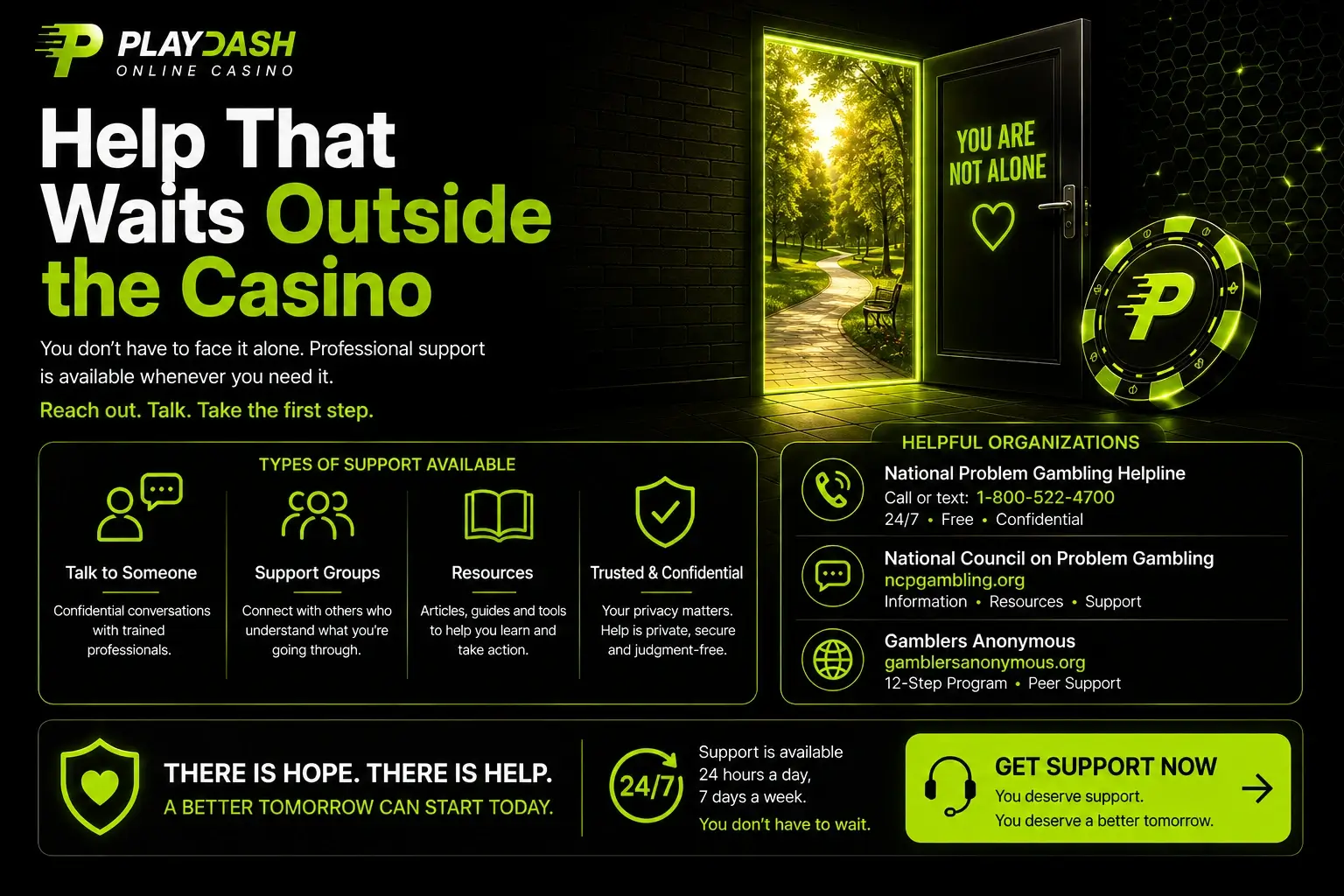
Casino controls can restrict access, but they cannot replace support outside the gambling environment. If limits repeatedly fail, financial problems are growing, or gambling has become difficult to discuss openly, involving another person or an independent service can change the situation more substantially.
Malaysia’s Ministry of Health recognises gambling disorder as a behavioural addiction and includes counselling and psychological approaches in its clinical guidance. Hospital Kuala Lumpur’s Psychiatry Addiction Unit also identifies compulsive gambling among the behavioural addictions it assesses and treats.
Independent Support Lines and One Honest Conversation
Useful starting points include:
- Gambling Therapy — global online support with confidential text-based live help, peer groups and multilingual assistance;
- Gamblers Anonymous — peer support with international, virtual and telephone meeting options;
- Malaysian healthcare services — local psychiatry or addiction services can provide professional assessment and treatment pathways;
- a trusted person — telling one partner, friend or relative what is happening can remove secrecy and make practical limits easier to maintain;
- current Malaysian support directories — local availability can change, so check current healthcare and counselling options rather than relying on an old hotline listing.
There is no need to wait until every red-zone sign appears. Amber is already a reasonable point to pause, reduce access and talk to someone.
The core rule remains simple: gambling should stay entertainment funded with money you can afford to lose. Do not chase losses, do not gamble with borrowed money, and do not let a planned limit become a negotiation once the session has started.